Published on April 20, 2026
Evergreen Brick Works was built to make things.
The bricks that built Toronto were made right here: pulled from the earth, tested and sent out to build a city. That spirit never left.
Today the campus looks different. Active construction, new infrastructure and Toronto’s beautiful ravine at the edge of it all. Every week, thousands of people move through our space. But the core idea is the same: this is a place where things get built, tested and proved. This is exactly why we’ve partnered with the Ontario Centre of Innovation (OCI).
Through OCI’s Critical Industrial Technologies initiative, Evergreen Brick Works is now a designated Technology Development Site. Ontario SMEs working in climate tech, construction, and property technology are testing their solutions here — in real-world conditions, on an active public campus — at no cost.
We spoke to five of these companies to learn more about the solutions they’re developing, how they’re testing them in real-world conditions, and the impact of having access to Evergreen’s Technology Development Site.

Who they are: Lowfoot is a data company that turns energy data into useful insights. Their platform helps manage and balance energy use more efficiently during the move toward cleaner, more decentralized energy systems.
Testing it at Evergreen Brick Works: Real-world conditions are crucial for testing new technology, but always involve some level of risk. You’re deploying new technology into a real operating environment that has real obligations to its users, tenants, and paying customers. But if your testing conditions are risk-free, you’re not in the real world, you’re still in a simulation.
The Technology Development Site at Evergreen Brick Works helped us accelerate so many parts of our R&D project. It was the project’s first deployment in Canada, which let us fix localization bugs, and gave us an important local reference point. Brick Works itself also combines a strong sustainability mandate with an exciting variety of systems, uses, and services, creating not only a powerful data set, but a strong motivation to advance the energy transition.
Right now, there are so many urgent needs in energy: cost reduction, decarbonization and the energy transition. You can’t start to address those needs unless you know how a building is using energy. This work is not new, and there are existing tools that give us some of that visibility, like smart meters. But to get to the next level, we have to be able to look inside the building to find the cost points, the efficiency opportunities, the emissions hot spots. Our project at the Brick Works let us demonstrate how this is possible. And, the multi-purpose nature of Brick Works means we can apply this to a wide variety of commercial and municipal facilities. Every business is unique, but energy transparency is a universal need.
–Peter Quinsey, CEO, Lowfoot
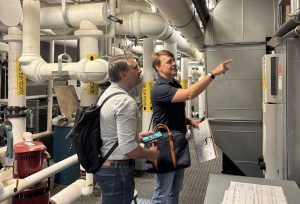
Who they are: Cence Power is an Ontario-based leader in safe, efficient power distribution for modern infrastructure. Our technology minimizes energy loss and reduces costs for telecom networks, data centers, and smart lighting.
Testing it at Evergreen Brick Works: When developing first-of-its-kind technology, customers demand real-world proof. To provide that, we have to get out of the lab. Partnering with Evergreen Brick Works allowed us to install our hardware in a live environment and gather feedback under diverse conditions. It was invaluable; we uncovered technical nuances that hadn’t appeared in our internal testing. By ‘testing to failure’ at a friendly third-party site, we ensure our customers never encounter those issues themselves.
At Evergreen, we installed a system that is virtually free of electrical shock and fire hazards. This allows us to deliver high-voltages of power using less copper and zero metal conduit. It’s a win for sustainability: we’re reducing carbon-intensive material use while significantly improving energy efficiency.
–Bolis Ibrahim, President, Cence Power

Who they are: Dougan Ecology is an ecological consulting and design firm dedicated to realizing the ecological potential of every place. Working at the intersection of ecological science, creative design, and advanced GIS and spatial analysis, the firm helps integrate nature into land‑use planning, development, and restoration. Through ecological interpretation, hands‑on fieldwork, and data‑driven, policy‑informed tools, Dougan Ecology supports nature‑based solutions that conserve and restore natural systems.
Testing it at Evergreen Brick Works: Introducing new technology into planning and environmental approval processes requires a high level of confidence, particularly in regulatory environments where decisions must be evidence-based, transparent, and consistent with established practice. Programs such as OCI play a critical role by supporting structured testing, validation, and early-stage adoption in real-world conditions.
Access to Evergreen’s Technology Development Site enables Dougan Ecology to test its solution in a real-world planning and infrastructure context that would be difficult to replicate internally. This includes conducting user testing, validating workflows against real planning scenarios, and gathering direct feedback from planners, designers, and policy staff. Without this access, testing would be largely limited to internal validation, reducing the ability to demonstrate practical value and accelerate adoption.
This technology supports sustainable and climate-ready development by enabling planners, architects, engineers, and landscape designers to integrate biodiversity and ecological function into projects from the earliest stages of planning. The result is more effective nature-based solutions, improved climate resilience, and fewer downstream redesigns during the approvals process.
–Steven Hill, Principal, Senior Ecologist, Dougan Ecology

Who they are: Trax builds digital tools that help architects, builders, and municipalities access and untangle building code requirements. The Trax Codes Revit Add-in makes it easier to integrate compliance earlier in the design phase by having the codes integrated directly into the design environment, helping projects move forward more quickly and accurately.
Testing it at Evergreen Brick Works: We’ve created a consolidated digital ecosystem for all of the regulations, building codes and requirements needed to build a structure across the country. Instead of leaving compliance until the end—when redesigns can be costly and time-consuming—we’re helping bring that process earlier, so there’s less rework, fewer surprises and fewer costly changes later on.
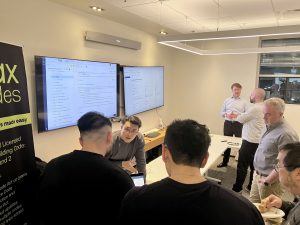
What we leveraged through the program was access to Evergreen’s network and partners. We were connected with a local architecture firm so they could test the integration, play with it and give us feedback on how it worked for them and what else they needed. It was less about physical testing and more about having professionals use the tool and share feedback in a workshop-style setting—brokering real-world relationships with people in professional practice to give really valuable input on our software.
If you can’t comply with the mandatory building requirements, you can’t reach toward more advanced goals like enhancing accessibility and sustainability. Our work helps make compliance more streamlined which as we continue to add more intelliegence to Trax, will allow people to more easily meet the minimum mandatory requirements across Canada.
–Ellen Hlozan, Director of Strategic Alliances, Trax
Who they are: TerreSky is a remote sensing company that collects and analyzes data to help monitor infrastructure and the environment. They are developing a system that brings this data together to help organizations better manage assets, reduce costs, and improve safety through clearer, data-driven insights.
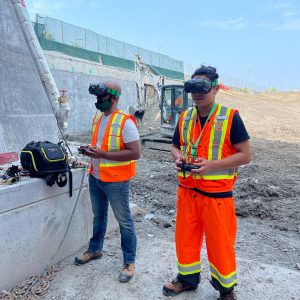
Testing it at Evergreen Brick Works: Evergreen Brick Works offers a diverse and complex environment for tracking things like invasive species, providing the rich, real-world data needed to train and improve their AI model. Without a site like this, development would be significantly slower.
As part of Evergreen’s Technology Development Site, this work supports more sustainable operations by shifting ecological monitoring from manual inspections to a more automated and precise system. The AI model helps track plant growth and the spread of invasive species, allowing organizations to move from reactive responses to more proactive environmental management.
Beyond the Brick Works site, TerreSky’s technology has broader applications for nature-based solutions and climate-ready infrastructure and buildings.
–Ryan Rizzo, Chief Executive Officer, TerreSky