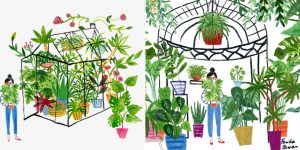
Born in Bangladesh, Farida Zaman has lived in the United Kingdom, the United States and now calls Toronto home. Evergreen spoke with the professional artist and children’s book author-illustrator about how her experiences around the world have shaped her art and illustration style.
Being of South Asian heritage and having lived in multiple countries, how would you describe your illustration style?
My illustration style is almost like patchwork imagery encompassing who I am, what I’ve seen, what I’ve learned from all the differences in places, colours and experiences that I’ve had the opportunity to experience. I have a global sense of culture, yet my art and stories can feel very local. From Bangladesh to England to Canada, all the mishmash of these cultural experiences has really given me more volume to my mind, adding more dimensions and levels of creativity.
Honestly, all these elements evoke this kind of feeling that is hard to describe in one way. It’s really helped shape who I am today, and you can see a lot of that in my work — my heritage and the amalgamation of cultures, and I love it and wouldn’t have it any other way.

As a children’s book author and illustrator, how important is nature for you?
Oh, it’s very important. I love plants and being around greenery. My garden at home is always a little unruly. It’s never tame. I like that organic feel which a lot of people say they feel through my art as well which I love.
For example, when I’m working on a children’s book, nature is so important to incorporate. If I’m writing or illustrating a story about a child in Bangladesh, I’ll research plants from that part of the world because that’s important to represent. I’ll research the heights of flowers, types of trees etc., and so, you will always see that representation in my work. I think it adds a lot of dimensions to a community that is unseen and can become an unconscious educational aspect to the story.
From an artist’s perspective, are public spaces in our cities needed?
Oh, it’s vital. I wish there was more emphasis on further developing better public spaces. My worry about Toronto is that there’s just too much emphasis on construction and high rises. I think it’s important to have places in the city where people can go, relax and enjoy nature at all times.
For me, I want to be able to meander through parks and reset my mind. I think we could all use more of that. We can always learn from and be inspired by what’s around us, and I believe we must work that much harder to make these places available, especially for children.
When I’m outdoors, I notice the language of colour and the play of light through nature. I think we have a lot to learn from nature — nature is our greatest teacher.