historicalebw_dronesite_unknownp_resized

Selected Work

We work with communities across Canada to create vibrant public places that help solve the most pressing issues cities face. Each project is a showcase of what’s possible. See our work below.

People walk around the Brick Works on a sunny summer day

Evergreen Brick Works

In 2010, Evergreen transformed a collection of deteriorating heritage buildings into a global showcase for green design. Today, these buildings make up Evergreen Brick Works, Canada’s first large-scale community environmental centre in the heart of Toronto. A green oasis, Evergreen Brick Works is open year-round. The site and surrounding trails and ravines welcome more than 500,000 annual visitors to experience its public markets, participate in conferences and events, enjoy outdoor learning and nature play, and explore public art.

Learn More
The challenge

When the old brick factory closed up shop in 1989, it left behind abandoned buildings and a hole in the ground the size of the Rogers Centre. In 1989, the Toronto and Region Conservation Authority (TRCA) acquired the site, and in 1995, the City of Toronto and TRCA began restoration work. During that time, Evergreen began to lead tree-planting activities in the Lower Don Watershed, and in 2002 began developing the plans for the innovative site that would become the Evergreen Brick Works.

The solution

Evergreen Brick Works now helps reconnect Torontonians with the rich natural heritage and recreational opportunities in the Don Valley Watershed. But, the space was also imagined as a showcase of sustainable design a hub for community engagement, which would serve as a model for scaling these ideas across the country. From mid-2000s, Evergreen launched the popular Saturday Farmers Market that connected communities, hosted summer programming that drew thousands of people and opened a children’s garden to help reconnect kids with the natural world. In 2010, the Brick Works officially opened as a year-round living demonstration of how past and present can work together to create greener models for urban living.

school ground with lots of greenery and pathways, with rocks for kids to sit on

Canada's first climate ready school

The Irma Coulson Public School in Milton, Ontario, became Canada’s first ever Climate Ready School in 2022. The school grounds were transform into a regenerative place where children can learn, develop and grow in their community while nature restores and renews the land around it. This pilot project has set new standards in stormwater management, topography, vegetated landscapes, material usage, retainment, seating and outdoor learning.

Learn more
The challenge

Schools are a significant component of public space in our cities and communities. They are hubs of learning and play where children build relationships with each other and the natural world. Schools also provide a vital space for habitat restoration, community use and climate adaptation. The Climate Ready Schools initiative holds the view that public school grounds are valuable assets with potential to have a positive influence on student development: physical and mental health, as well as learning and social behaviour. Irma Coulson’s school ground faced challenges common to many Canadian school grounds, including a lack of shade and shelter, heavy compaction leading to seasonal ponding, and a distinct lack of features to support play and learning.

The solution

To transform the compacted, featureless grounds at Irma Coulson, Evergreen introduced nature-based design elements that support play, learning and ecological restoration. The redesign integrates lessons from Berlin’s Sponge Schools project, aiming to absorb 100% of rainfall on site and reduce flood risk in the surrounding neighbourhood. A climate-adaptive approach added trees, topography and permeable materials, while ideas from students and families directly shaped the space. The result is a resilient, community-informed landscape that improves wellbeing and models a climate-ready future.

The partnerships

Evergreen worked with the Halton District School Board to transform their school grounds, in collaboration with with Berlin-based landscape architect Birgit Teichmann, along with local Canadian landscape architects. Canada’s first climate ready school ground was made possible by funding contributions from the Balsam Foundation, the Intact Foundation, the LCBO Spirit of Sustainability fund along with an anonymous funder, with in-kind support by ARUP.

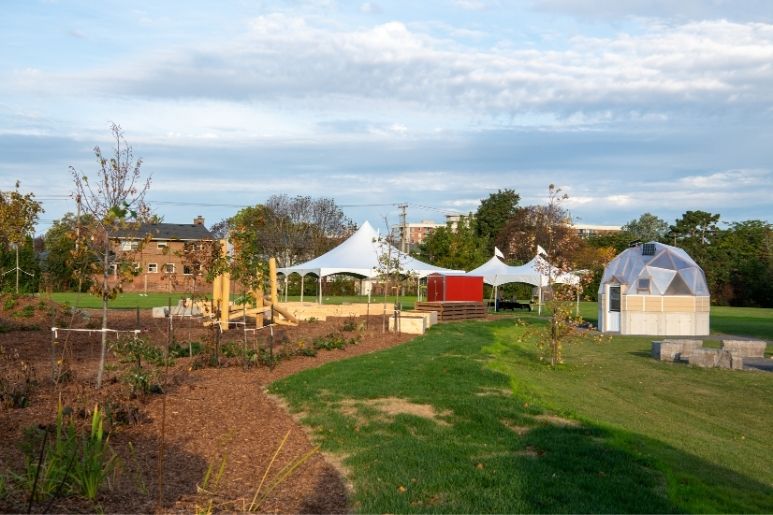
A birds eye view of the Don Valley Brick Works

The Loop Trail

The Loop Trail Project, part of the City of Toronto’s Ravine Strategy, is a 72 km circular trail connecting ravines, neighbourhoods, and the waterfront. It aims to promote active transportation, healthy living, and environmental stewardship while celebrating Toronto’s natural and cultural heritage.

Learn more
The challenge

The Loop Trail envisions a Toronto that is connected to thriving natural systems, that encourages active and healthy living and is open and accessible to all. It is an invitation to explore the city, discover new connections with nature and neighbouring communities, and to participate in caring for the trail through public programming and stewardship. The trail will support residents and visitors to walk, cycle and run in the ravine corridors of the Don and Humber valleys, the Finch Hydro Corridor and the Lake Ontario waterfront.

The solution

The Loop Trail will bring together many disconnected trail fragments into a new whole to connect Toronto’s globally unique ravine system with its incredible diversity of people and neighbourhoods. Evergreen has helped spearhead the development of Loop Trail Hubs — locations that enhance trail use with amenities, programs and community-driven services. These hubs highlight the unique character of Toronto’s neighborhoods while improving access to nature. To drive this work, we are hosting participatory workshops, offering design and visioning expertise and supporting public programming like festivals, art installations and educational activities.

The partnerships

Evergreen is collaborating with the City of Toronto, Toronto and Region Conservation Authority, the Toronto Foundation and a number of supporters on the Loop Trail. Our partners on the Loop Trail Hubs are the Learning Enrichment Foundation, Toronto Botanical Gardens, Black Creek Community Farm and Waterfront Toronto.

Children climbing trees at Neighbourhood Nature Play in Kitchener, Ontario.

Neighbourhood Nature Play

The Neighbourhood Nature Play project was a pilot in partnership with the City of Kitchener, aimed at building regular, year-round outdoor play opportunities in Gzowski and Kingsdale Parks — both located in underserved neighbourhoods.

Learn more
The challenge

It’s easy for children to get swept up in a world of technology and indoor activities — spending three times as many hours on screens as outside. But children need the luxury of slowness and groundedness that nature truly offers. They need places that spark a lifelong love for the natural world and bring them into step with the rhythms of the seasons. This multi-year initiative was devoted to getting children and their families to play and learn in nearby nature. During park open houses, Evergreen heard from the community that they wanted more opportunities in nature-based play.

The solution

Working closely with the community, Evergreen made strategic design/build interventions to increase nature contact and play value for children and families. At the parks, Evergreen’s trained staff delivered free, year-round programming that fostered an environment for immersive, social, and adventurous play. The combination of thoughtful design elements and dedicated staff created a place in the neighbourhood where children could explore freely, engage with others, and take healthy risks. Children were encouraged to become the architects of their surroundings, using their creativity and skills to invent and build with a variety of “loose parts” materials—flexible, open-ended items that they could spontaneously create with. This innovative project championed a collaborative, child-centered design approach, transforming ordinary parks into dynamic community hubs. At the heart of this transformation were three key elements: play animators, loose parts, and a focus on nurturing self-directed, adventurous play.

The partnerships

The Neighbourhood Nature Play initiative was created in partnership with the City of Kitchener, and generously funded by the Lyle S. Hallman Foundation and the Ontario Trillium Foundation.

dsc00540

Mabelle Park

A transformation 15 years in the making, Mabelle Park includes a new multi-use building, a range of park improvements and public artworks in an underserved neighbourhood.

learn more
The challenge

Only just a few years ago, Mabelle Park in central Etobicoke, Ont. was nearly a forgotten and neglected space except for its role as a thoroughfare for community members on their way to school or the subway. The aim was to respond to the unique needs and desires of residents living together in a high density, low-income tower community.

The solution

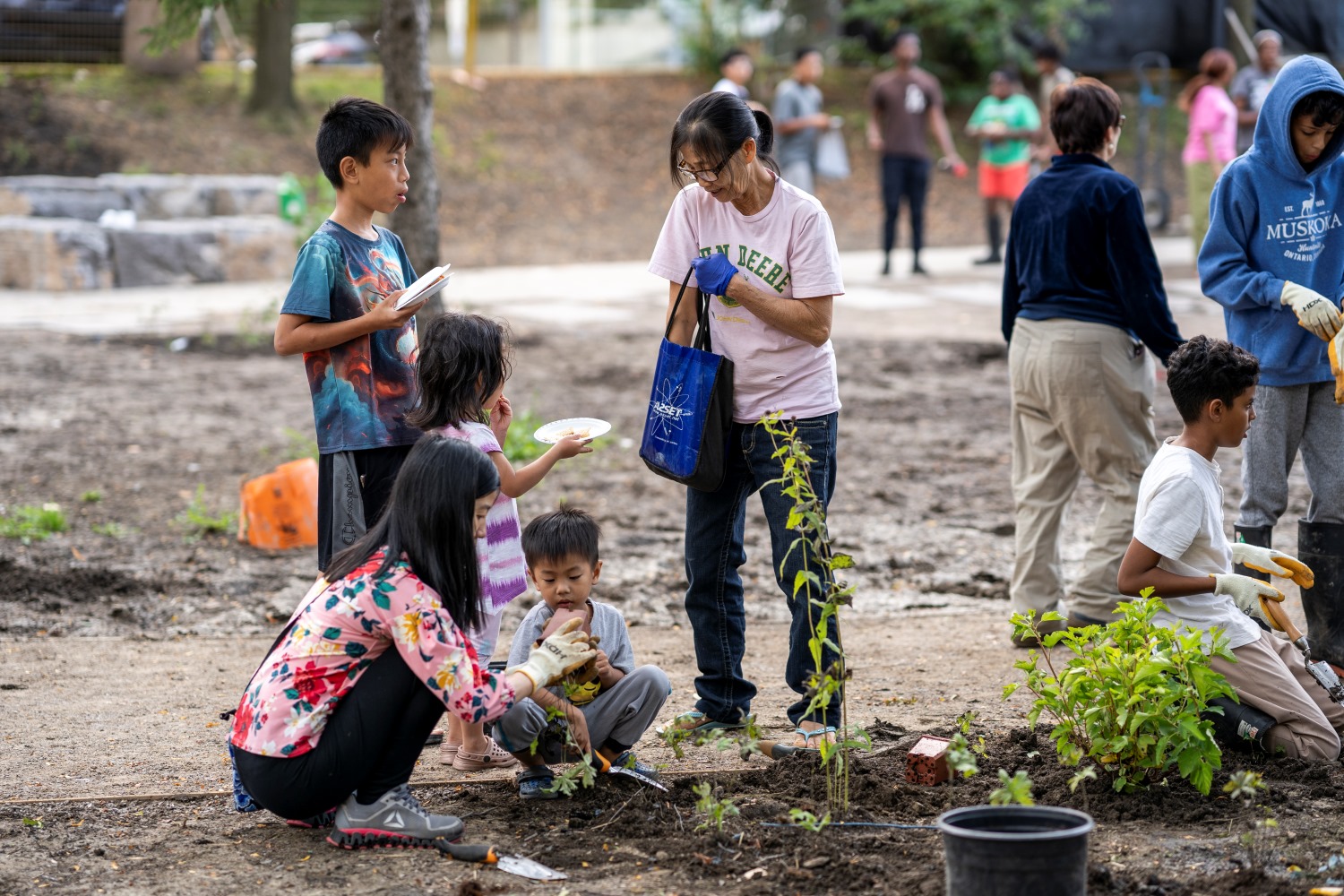
Mabelle Arts, the non-profit that led the revitalization, developed a unique community consultation process inspired by the community’s rich history of engaging in arts projects over the years. More opportunity for community participation arose through an innovative approach to landscape design — and Evergreen partnered with Mabelle Arts to lead three community engagement days to help the neighbourhood come together to plant trees and shrubs. Everyone from kids to seniors showed up ready to lend a hand.

The partnerships

The revitalization was led by Mabelle Arts, a non-profit group, and co-designed with the direct input of the community. Learn more about the Mabelle Park transformation at mabellearts.ca.

education-plantbased

ClearWater Farm

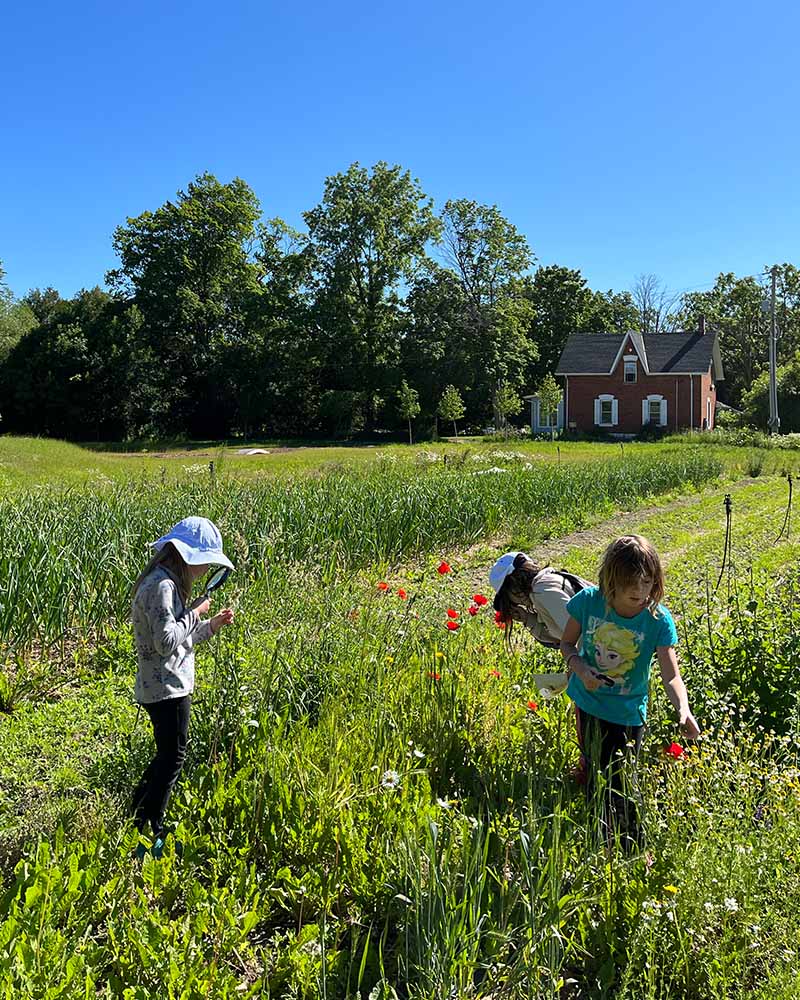
ClearWater Farm is a not-for-profit farm on the shores of Lake Simcoe in Willow Beach, Ont. The farm focuses on place-based education, hands-on farming, water conservation and local economic development. It’s a place where kids get their hands dirty in the garden, their boots muddy exploring nature, and their curiosity sparked by fresh food and water. A new kids play area is being developed, called The Wild Place.

The challenge

The mission at ClearWater farms is to deepen young people and their families’ connection with the natural environment, marrying the arts, science and technology to cultivate a more sustainable future. While ClearWater Farm offers a welcoming public space with plenty for families to explore, While the farm is full of opportunities for families to explore and learn together, ClearWater identified a need for a dedicated space designed especially with children in mind — a place where young visitors can engage, play and connect with nature in their own way.

The solution

To bring this vision to life, ClearWater Farm is partnering with Evergreen, ReCreate Place and Lakeview Public School to co-create a new nature play area called The Wild Place. Local students took part in hands-on design sessions that explored empathy, habitats and shared space with other creatures. Their ideas — from imaginative play zones to structures inspired by nature — helped shape the early concepts. The process centres kids not just as users of the space, but as its designers.

The partnerships

ClearWater Farm is partnering with Evergreen, ReCreate Place and Lakeview Public School to co-create The Wild Place.

Get the Evergreen newsletter

This isn’t just another org update. The Evergreen newsletter is a conversation about the most pressing city-building issues. Subscribe for stories, interviews, events, resources, careers and more.