This story was translated from French. Click the link in the sidebar to read the orginal french version.
In a world where we’re increasingly glued to our screens, how can we get kids disconnected and outdoors?
A Canadian government report found that increased screen time was associated with poor mental health in children and young people. It’s the alarming impact of sedentary lifestyles that has encouraged nature education movements across Canada. And where better to introduce nature-based learning than some of our very best public spaces — places like Mont-Royal Park in Montreal.
To learn more, I spoke with Laure Gicquiaux, head of educational services at Les Amis de la montagne, a charitable organization created in 1986 to protect and promote the natural and cultural heritage of Mount Royal, a 545-acre urban park that serves as a destination for activities such as walking, hiking and ice skating.
As part of their conservation and preservation efforts, Les Amis de la montagne offers educational programs to help children learn new skills, develop their relationship with nature, get outdoors and have fun.
Evergreen: What makes Mount Royal such a beloved public space in the city?
Laure Gicquiaux: Mount Royal is a visual landmark that is part of Montreal’s identity. It is also a source of pride that has always been present in the landscape and throughout the history of the city of Montreal. Many people have memories associated with Mount Royal: their first skiing experience, the snowshoeing they enjoyed when they were young, watching concerts or celebrating Saint-Jean-Baptiste Day.
People often return there. The connection grows, and it becomes their mountain. On their first visits, they naturally go to the lookout and enjoy the most popular features. Then, little by little, they explore the forest, find a quiet place to rest and discover other, more hidden corners of Mount Royal, which also helps them make it their own over time.
In addition, climate change is highlighting the importance of green spaces, especially large ones. Several studies have been conducted in recent years on global warming, indicating a ten-degree difference between Mount Royal and downtown. The mountain becomes a veritable green oasis in the middle of the city when it is very hot.

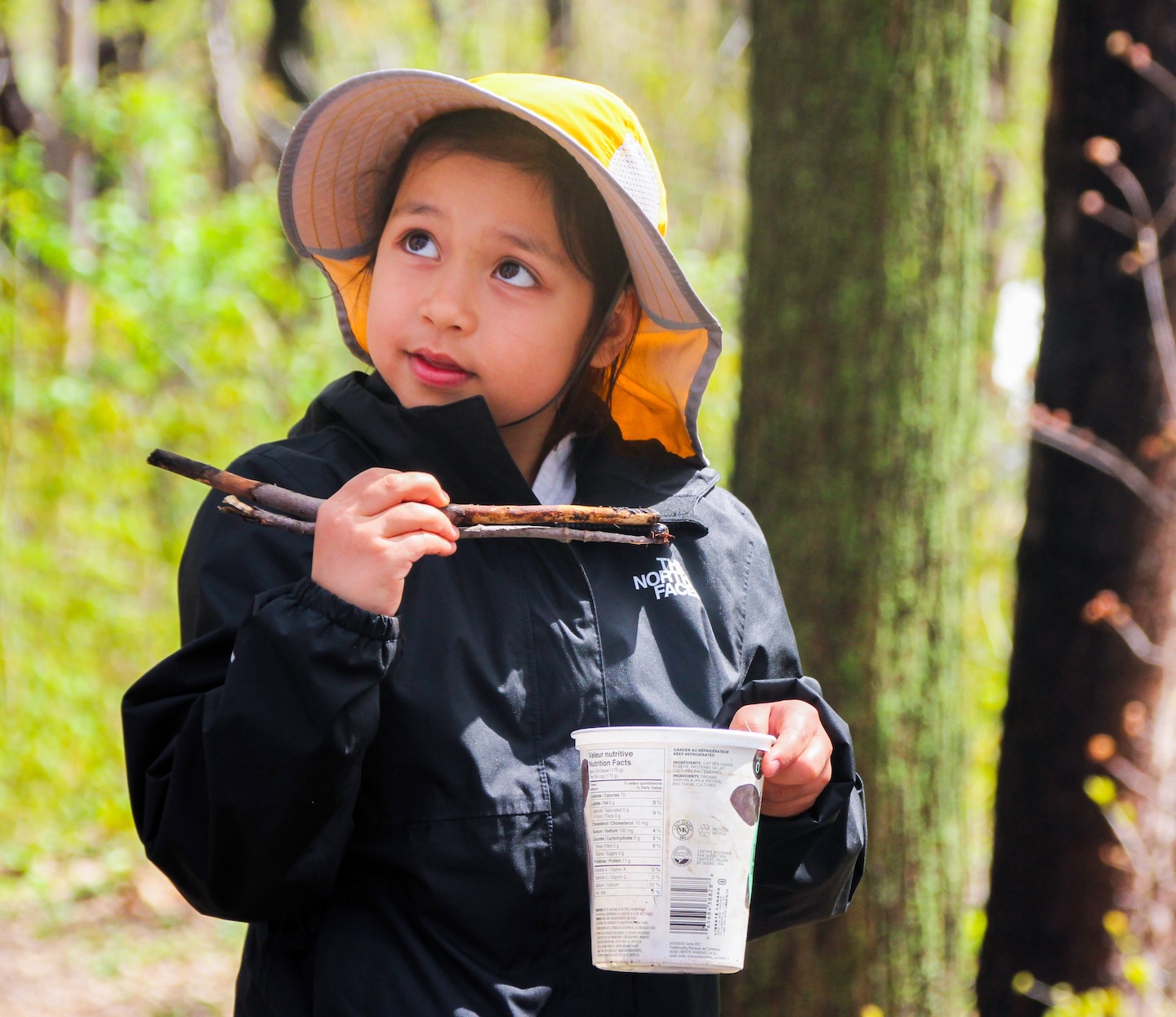
Photo credit : Les Amis de la montagne
Evergreen: What can children learn in an outdoor classroom that they cannot learn in a traditional classroom?
LG: There is increasing discussion about outdoor education, and I believe that school and nature are complementary. In nature, young people learn things that cannot be taught in school.
Nature is an open, living and dynamic environment where young people learn to look around, observe and listen, which greatly develops their curiosity. This curiosity leads them to ask questions that spark reflections outside the school curriculum.
And experiential learning is always more memorable! For example, we have outings to observe birds. Sometimes, three months later, the young people are still able to name the species of birds they saw. It shows that something meaningful happened that day. While the teacher likely reviewed the material back at school, actually seeing the birds in real life may have helped the memory stick.
Finally, we have noticed that young people with learning difficulties, for whom sitting still in a closed classroom is difficult, do better in nature. Being able to move around and learn in nature satisfies their curiosity.
At Les Amis de la montagne, we want to train tomorrow’s protectors of Mount Royal. Our mission is to create an emotional bond between Mount Royal and its visitors. It is the wonderment of young people that ultimately makes them want to protect the mountain and trains the protectors of tomorrow.
Evergreen: Can you explain the concept of forest schools?
LG: The concept of forest schools originated in Denmark in the mid-20th century. It stems from the observation that young people are not spending enough time in nature, which is affecting their development. The example I often use is the use of tablets, which means that we see everything in 2D rather than 3D, and we use our fingers but don’t hold objects, which affects motor skills and distance vision.
The aim of forest schools is to compensate for this lack of nature in order to develop motor skills, self-confidence, communication skills, curiosity, independence and an emotional connection with nature.
This concept arrived more recently in Canada, between 2005 and 2010. At Les Amis de la montagne, we have been interested in the forest school and its principles since 2013. Educators introduce young people to activities, but it is the young people themselves who decide whether or not they want to participate in what is offered to them. It is important to be able to adapt to what we see in the field and to constantly respond to what young people discover. Even if it means looking things up in books together afterwards. The approach is based on curiosity and receptivity to our surroundings.
One of the essential principles in forest school is not to use the word “no.” Instead of prohibiting, we question young people about their intentions: “Why do you need to use such a big stick?” “Do you think that’s a good idea?” Then guide them in their thinking and risk management rather than forbidding it. The aim is to develop their critical judgment.

Photo credit : Les Amis de la montagne
Evergreen: What advice would you give to parents and caregivers who want to reconnect their children with nature?
LG: Start as early as possible! Even before children can walk, being outdoors helps develop habits. They can hear sounds and touch things, so the earlier you start, the more it will benefit their overall development.
You don’t have to be in a large natural space: a tree or the park around the corner from your house is enough. The important thing is to find a place where you feel comfortable, where you don’t have to worry about risk management if you’re anxious, rather than preventing you from doing it.
There are also lots of online resources with ideas for activities, information on what to pack in your child’s bag, practical advice on dealing with minor injuries and so on.
So, trust yourself, everything will be fine, and try to take it step by step: ten minutes, fifteen minutes, thirty minutes.
Learn more
Ready to explore nature-based education? If you live in Montreal, Les Amis de la montagne offers forest school on Mount Royal for different age groups.
If you’re closer to Toronto, Evergreen Brick Works offers unique programming for kids and youth to explore the city’s ravine systems in the heart of the Lower Don Valley.
But you can also enjoy nature education anywhere. Visit our Outdoor Classroom resource hub for stories, activity books and videos. The most important thing is to get started and try for yourself!